
Reserve Bank Governor Shaktikanta Das on Thursday said the fundamental drivers of the Indian economy are gaining momentum and the country is moving on a sustainable growth path. In the inaugural address at FIBAC 2024, the governor said that massive changes are taking shape in various economic sectors and markets, and the country is geared for orbital shifts.

A gradual approach to privatise public sector banks (PSBs) is more ideal than taking a big-bang approach, a study by Reserve Bank of India (RBI) staff has concluded. It has backed the government's idea to privatise two PSBs initially. Such a gradual approach would ensure that large-scale privatisation does not create a void in fulfilling important social objectives of financial inclusion and monetary transmission, the study has argued.

Ask rediffGURU and tax expert Mihir Tanna your income tax-related questions.

'Today, let us reaffirm our commitment to strive to realise Gandhiji's dreams. His watchwords, truth and nonviolence, will continue to remain relevant for the whole world. He also taught us that rights and duties are but the two sides of the coin - indeed, the true source of rights is duty. Today we recall his lessons in compassion too - compassion not only for our human neighbours but also for our other neighbours, namely, flora and fauna, rivers and mountains.'

331,602 Indians are studying in the US, making India the 'top sender' of international students to America for the first time in 15 years, as it overtook China for the academic year 2023-2024.

It further said India is facilitating external commercial borrowings by startups in order to encourage innovation and promote ease of doing business.

Cricket has been the driving force behind change in the sporting ecosystem in India but women's participation in other sports in the country still needs more support and platforms for exposure.
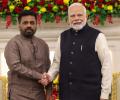
Sri Lankan President Anura Kumara Disanayaka assured Prime Minister Narendra Modi that his country's soil will not be used against India's interests, addressing concerns over China's growing influence in Colombo. The two leaders discussed a range of issues, including a defense cooperation agreement, energy ties, and debt restructuring. They also agreed to initiate a ferry service between Rameshwaram and Talaimannar, and to adopt a "humanitarian approach" to the fishermen issue.

Indian fintechs and associated entities are hoping that the Union Budget 2024 will provide a boost and empower firms to extend their reach beyond Tier-II regions, with an emphasis on supporting enterprises led by women. The fintech industry, which has witnessed regulatory reforms over the last year, expects the Budget, scheduled to be presented by Finance Minister Nirmala Sitharaman on February 1, will further encourage financial inclusion, empower micro-small-medium enterprises (MSMEs) with lending solutions, and push for upskilling initiatives for the country's young workforce.

These smart cities should have the capacity to absorb, adapt and provide opportunities for both the poor rural migrants as well as the educated professionals, say Sujit K Pruseth & Sachi Satapathy.

Following a review of peer-to-peer (P2P) platforms, certain issues -- including high non-performing asset levels, significantly high balances in escrow accounts, and non-compliance with net owned fund and disclosure requirements -- came to the RBI's attention.

Growing at a robust rate due to economic reforms in key sectors like digitisation and infrastructure, India has emerged as a star performer and is projected to contribute more than 16 per cent of the global growth, the International Monetary Fund said on Monday. "What we have been observing for quite some time now is that India has been growing at a very robust rate. "It's one of the star performers when it comes to real growth when you look at peer countries.

Prime Minister Narendra Modi on Tuesday said India will become the growth engine for the world in the coming years, and the ease of doing business has improved with "mission-mode" reforms being undertaken by his government. Speaking at the BRICS Business Forum Leaders' Dialogue in Johannesburg, Modi also said India soon will become a $5 trillion economy.
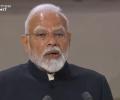
Prime Minister Narendra Modi advocated for a global framework for artificial intelligence (AI) based on open source, emphasizing the need for trust, transparency, and the elimination of biases. Co-chairing the AI Action Summit with French President Emmanuel Macron, Modi highlighted the transformative potential of AI across various domains, including politics, economics, security, and society. He stressed the importance of democratizing technology, addressing concerns about cyber security and disinformation, and developing quality data sets free from biases. Modi also acknowledged the need for open-source AI ecosystems to foster trust and transparency, while emphasizing the importance of localized technology for effectiveness and usefulness. Recognizing the potential of AI to improve health, education, and agriculture, Modi proposed pooling resources and talent to leverage the technology for sustainable development goals. Addressing concerns about job displacement, he emphasized that while the nature of work may evolve, technology creates new opportunities. Modi highlighted India's leadership in AI adoption and data privacy solutions, emphasizing the nation's readiness to share its expertise and contribute to an AI future that benefits all.

Market downturns or regulatory shifts can reduce liquidity, making it harder to buy or sell assets when needed.

There are challenges galore before him, and it is not going to be easy. In the next four years, he has to conjure a system that changes the optics about him and the BJP both nationally and internationally so that he can ride back on his own, claim the top slot, and not have to lean on a coalition, asserts Ramesh Menon as Modi 3.0 completes a year in power.

'Tennis is a sport where you may enjoy watching more than playing. But pickleball flips that -- once you get the bug, you want to play more than watch.'

Dream11, Baazi Games, Zupee and WinZO among others are invited for the discussion with the anti-money laundering watchdog.

The RBI has doubled the limit of maximum balance that an individual customer can hold with payments banks to Rs 2 lakh from Rs 1 lakh earlier with immediate effect to expand the ability of such lenders to cater to the needs of MSMEs and other businesses.

"The PMJDY has been the foundation stone for the Modi government's people-centric economic initiatives. "Whether it is direct benefit transfers, Covid-19 financial assistance, PM-KISAN, increased wages under MGNREGA, life and health insurance cover, the first step was to provide every adult with a bank account, which PMJDY has nearly completed," Nirmala Sitharaman said on the sixth anniversary of the scheme.

'The focus needs to shift towards the ability to collect payments, particularly in tier-3 to tier-4 areas where acceptance is still lacking.'

Addressing a G20 Summit session, Modi also presented his '5-I' vision to maximise digital technology for social benefit.

Reserve Bank of India (RBI) deputy governor M Rajeshwar Rao on Wednesday defended the central bank's decision of not allowing industrial houses to float banks, and said more deliberations are needed before RBI changes its stance on this issue agreed back in 2001. An internal working group (IWG) of the RBI had recommended allowing industrial groups into banking, but late last month the RBI said it kept on hold the two recommendations of allowing industrial houses and large non-banks to float banks. However, RBI had accepted 21 of the 33 recommendations of the group that submitted its report a year ago.

Former RBI governor D Subbarao has suggested that the government should come up with a 10-year road map for privatisation of all Public Sector Banks (PSBs) as it would provide much needed predictability to stakeholders. Subbarao further said that the big bang approach to privatisation of state-owned banks is not desirable but at the same time the issue should not be put on the back burner. "Ideally, we should have a road map, maybe over a 10 year timeframe, to privatise all PSBs. "That will give much needed predictability to all stakeholders," he told PTI.

Dr Shakeeb Ahmed Khan, a physiotherapist who works with specially abled children and adults, debunks the myths and helps us understand how to deal with and support individuals with autism.

Foreign investors have adopted a cautious stance and infused Rs 7,320 crore in the Indian equities in August owing to high valuation of stocks and the unwinding of the Yen carry trade after Bank of Japan raised interest rates. This investment was way lower than Rs 32,365 crore in July and Rs 26,565 crore in June, according to data with the depositories. While September is likely to see continued interest from FPIs, the flows would be shaped by a combination of domestic political stability, economic indicators, global interest rate movements, market valuations, sectoral preferences, and the attractiveness of the debt market, Vipul Bhowar, Director Listed Investments, Waterfield Advisors, said.

Chief economic advisor V Anantha Nageswaran on Tuesday said Indian economy will grow at over 7 per cent, down from above 8 per cent of growth rate projected in January. He, however, said that the economic momentum and the animal spirits are "unmistakable". "India's own growth rates have come off the projections made in January down to about 7-plus per cent for the current financial year," Nageswaran said speaking at Global Fintech Fest event in Mumbai.

The poor and unbanked can take their rightful place as consumers of financial services only if the Modi government encourages different entities to advance the financial inclusion agenda, say Vikram Gandhi & Chandni Ohri.

Fintech firm One97 Communications -- owner of the brand Paytm -- has shifted its nodal account to Axis Bank from Paytm Payments Bank. The move will allow continuity of Paytm QR, Soundbox, card machine after the March 15 set by the Reserve Bank of India (RBI), as per a regulatory filing. The RBI has advised customers and merchants of Paytm Payments Bank Ltd (PPBL) to shift their accounts to other banks by March 15, giving 15 more days to the beleaguered entity to close most of its operations, including deposit and credit transactions.

After a robust 2023, foreign investors significantly scaled back their investments in Indian equities in 2024, with net inflows amounting to over Rs 5,000 crore, as elevated domestic valuations, coupled with geopolitical uncertainties prompted investors to adopt a more cautious stance. Looking ahead to 2025, FPI flows into Indian equities could see a recovery, supported by a cyclical upswing in corporate earnings, particularly in domestic-oriented sectors like capital goods, manufacturing, and infrastructure, Vinit Bolinjkar, head of research, Ventura Securities, said.

Finance Minister Nirmala Sitharaman on Saturday said the government will arrange identity cards and registration on the e-Shram portal to assist 1 crore gig workers. Presenting the Union Budget 2025-26, the finance minister also said a scheme for the socio-economic upliftment of urban workers will be implemented.

By June 2025, financial freedom will be just an ATM away. Pleasantly surprised? But there's more, says Ramalingam Kalirajan

Leading oil companies dedicated the second day of India Energy Week (IEW) 2025 to announcing strategic deals and business agreements across the supply chain - from sourcing more crude oil supply to deploying more domestic ships and building gas distribution capacity.

The Indian equity markets will soon account for over a fifth of a key emerging market (EM) benchmark tracked by funds with assets exceeding $500 billion. This development is expected to funnel as much as $3 billion into the domestic markets. Following the latest review undertaken by global index provider MSCI, India's weighting in the MSCI EM index will surpass 20 per cent for the first time, narrowing its gap with the current top-weighted China to fewer than 400 basis points.
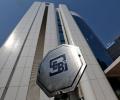
Before framing regulations to curb 'misleading' messages and stock recommendations by finfluencers (a portmanteau of the phrase 'financial influencers'), the market regulator plans to put in place some 'building blocks' to ensure smooth enforcement. Madhabi Puri Buch, chairperson of Securities and Exchange Board of India (Sebi), is of the view that the 'traditional approach may not work' to rein in finfluencers. "There are many interlinked pieces in our regulations - investment advisor regulations, research analyst regulations, the fact that we don't have algorithmic (algo)-related regulations, what brokers are permitted to do, and what is incidental advice.

'Spend, but create assets, spend but make sure that people benefit from it.' 'This has been a beautiful guiding principle. And I think as a finance minister I owe so much to the prime minister for keeping this path clear before us.'

Taxing capital less may not lead to more investments but taxing more will drive capital away, Chief Economic Advisor V Anantha Nageswaran on Friday said during a discussion on Inequality, Economic Growth and Inclusion. While it is easy to drive capital out, bringing it back is a lot harder, said Nageswaran.

India has been ranked very low, mostly in the bottom half, globally on most of the parameters for inclusive growth and development even as it fares much better internationally when it come to business and political ethics.

India's lack of financial inclusion is well known but that slightly more than 50 per cent of the population just has a simple savings bank account is distressing.

With digital adoption fast gaining currency, India is likely to see retail digital payments double to $7 trillion by 2030 from current levels, a study by Kearney and Amazon Pay said. In the report 'How Urban India Pays', Kearney-Amazon Pay said strong adoption of digital payments in online purchases has potentially led to a permanent shift in consumer behaviours, fuelling offline adoption as well.
